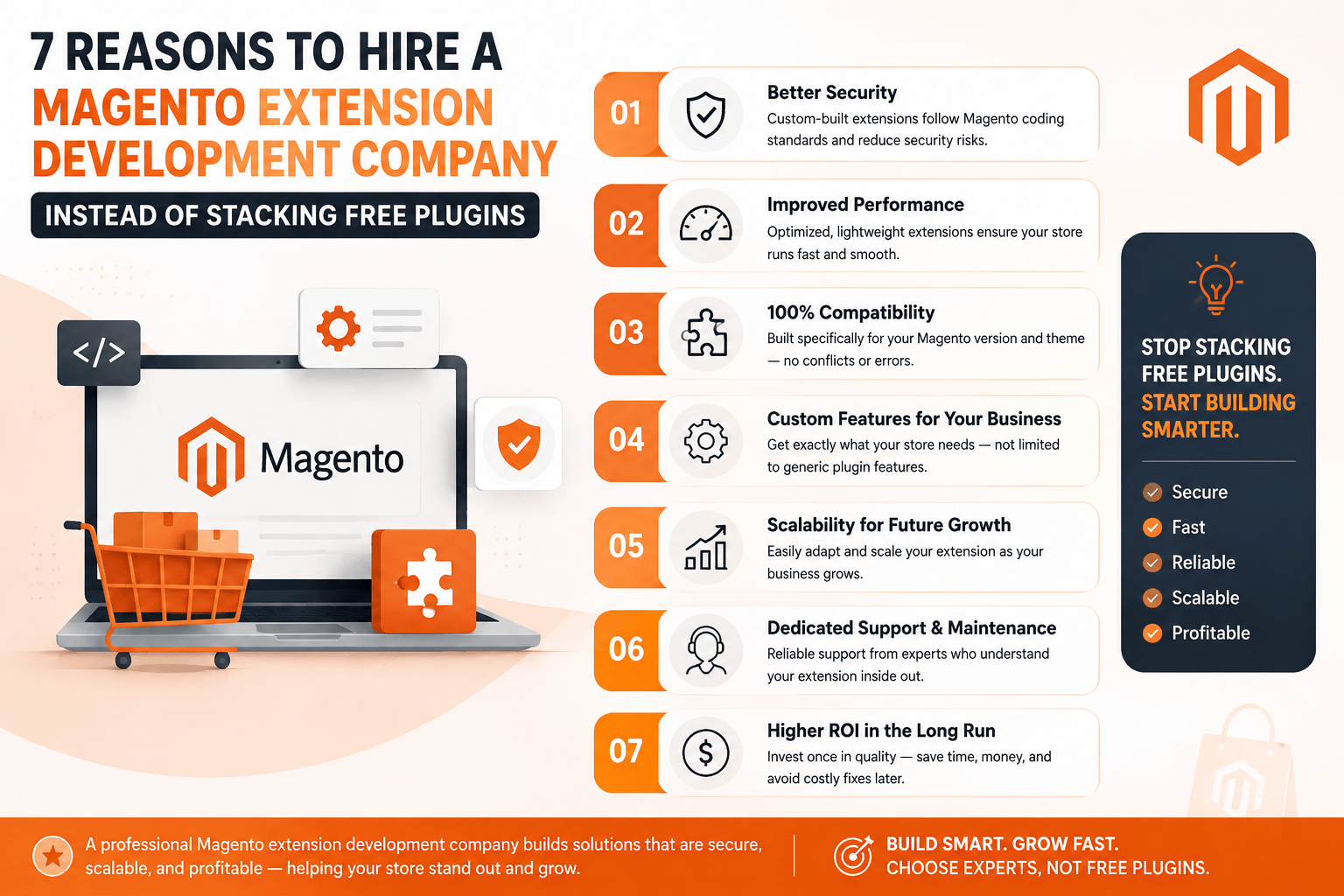
Every Magento store owner has been there. You need one small feature — maybe a better search filter, a loyalty program, or a custom shipping rule — so you go hunting through the Marketplace, find a free plugin that looks close enough, install it, and move on. Then you need another feature. And another. Six months later, your store is running on a dozen free plugins from a dozen different developers, none of which were ever designed to work together.
This is exactly the point where most Magento store owners start looking into hiring a Magento extension development company instead of continuing to bolt on more free tools. Here’s why that switch actually makes sense — not as a sales pitch, but as a practical look at what stacking free plugins costs you over time.
1. Free Plugins Weren’t Built to Work Together
Every plugin developer writes code assuming their extension is the only one touching a particular part of your store. When you install ten of them, you’re gambling that none of them modify the same files, override the same classes, or hook into the same events. They usually do — and when they collide, you get broken layouts, checkout errors, or features that silently stop working.
A Magento extension development company builds with your existing setup in mind. Instead of guessing whether a new module will play nicely with what’s already installed, they test it against your specific store before it ever goes live.
2. You Lose Control Over Code Quality
Free extensions vary wildly in quality. Some are abandoned after one release. Some were written years ago and never updated for newer Magento versions. Some quietly introduce performance bottlenecks that only show up once your traffic grows. You often don’t find out until something breaks in production, and by then, the original developer may not even be reachable.
Custom Magento extension development means the code is written specifically for your store, reviewed against your standards, and documented — so you’re not inheriting someone else’s unmaintained side project.
3. Security Risks Add Up Fast
Every plugin you install is another potential entry point for vulnerabilities. Free extensions, especially ones without active maintainers, often go months or years without a security patch. Multiply that across ten or fifteen plugins, and you’ve built a surprisingly large attack surface without realizing it.
A Magento development company that builds custom modules is accountable for that code long-term, which means patches, updates, and security reviews happen on a schedule — not whenever (or if) a volunteer developer gets around to it.
4. Performance Takes a Hit With Every Extra Plugin
Each plugin adds its own scripts, database queries, and admin panel overhead. Individually, a single free plugin might not slow your store down much. Stack enough of them, and your page load times start creeping up, your checkout gets sluggish, and your Core Web Vitals scores drop — which affects both user experience and search rankings.
Custom-built extensions are leaner by design. A development team builds exactly the functionality you need, nothing more, which keeps your store’s performance intact as you scale.
5. Support Becomes a Guessing Game
When something breaks with a free plugin, your support options are usually limited to a forum thread, an outdated FAQ page, or an email that may never get answered. There’s no accountability, no SLA, and no guarantee the original developer is even still maintaining the extension.
Hiring a Magento extension development company changes that entirely. You get a direct point of contact, documented support terms, and someone who actually understands the code because they wrote it.
6. You End Up Paying More in the Long Run
Free plugins look like the budget-friendly option upfront, but the real cost shows up later — in dev hours spent untangling conflicts, in lost sales from bugs that went unnoticed, in emergency fixes when something breaks during a sale. What seemed like free functionality quietly becomes one of your biggest ongoing expenses.
Custom Magento extension development has an upfront cost, but it’s a predictable one. You know what you’re paying for, and you’re not stacking hidden maintenance costs on top of a dozen disconnected tools.
7. Your Store Stops Feeling Like “Your Store”
This one’s less technical but just as real. When your functionality comes from a patchwork of generic plugins, your store ends up feeling like everyone else’s Magento store — same features, same limitations, same generic admin panels bolted on top of each other.
Custom extensions let your store do exactly what your business needs, in a way that actually matches how your customers shop. That’s the difference between a store that works and a store that feels genuinely built for your brand.
When Free Plugins Are Actually Fine
To be fair, free plugins aren’t inherently bad. For a small store just getting started, with light traffic and simple needs, a well-reviewed, actively maintained plugin can absolutely do the job. The problems start once your store grows in complexity, traffic, or the number of “small” features you’ve stacked on top of each other. That’s usually the point where a custom Magento module development approach starts paying for itself.
If you’re at that point and want a second opinion on whether your current plugin stack is holding your store back, Team Magento regularly audits stores exactly like this — the pattern is almost always the same, and it’s usually fixable without a full rebuild.
Frequently Asked Questions
Q1. When should I switch from free plugins to a custom Magento extension?
Once you’re running more than five or six plugins, or you’ve noticed conflicts, slow page speed, or checkout issues, it’s usually time to consider custom Magento extension development instead of adding another free tool to the pile.
Q2. How much does custom Magento extension development cost compared to free plugins?
Free plugins have no upfront cost but often carry hidden long-term costs from conflicts, security patching, and lost sales. Custom extension development has a clear upfront investment, typically ranging from a few hundred to several thousand dollars depending on complexity, but avoids the ongoing maintenance headaches of a patchwork plugin stack.
Q3. Can a Magento extension development company fix issues caused by free plugins I already installed?
Yes. Most Magento development companies offer audits to identify which plugins are conflicting, outdated, or unnecessary, then recommend whether to fix, replace, or consolidate them into a single custom solution.
Q4. Do custom Magento extensions slow down my store like plugins do?
Not typically. Custom extensions are built to do only what your store specifically needs, without the extra bloat that comes from generic, one-size-fits-all plugins, which generally makes them lighter and faster.
Q5. Is it worth hiring a Magento extension development company for a small store?
It depends on your growth plans. If you’re just starting out with simple needs, well-reviewed free plugins can work fine. But if you’re planning to scale, custom extension development early on can save you from a messy, conflict-prone plugin stack later.

